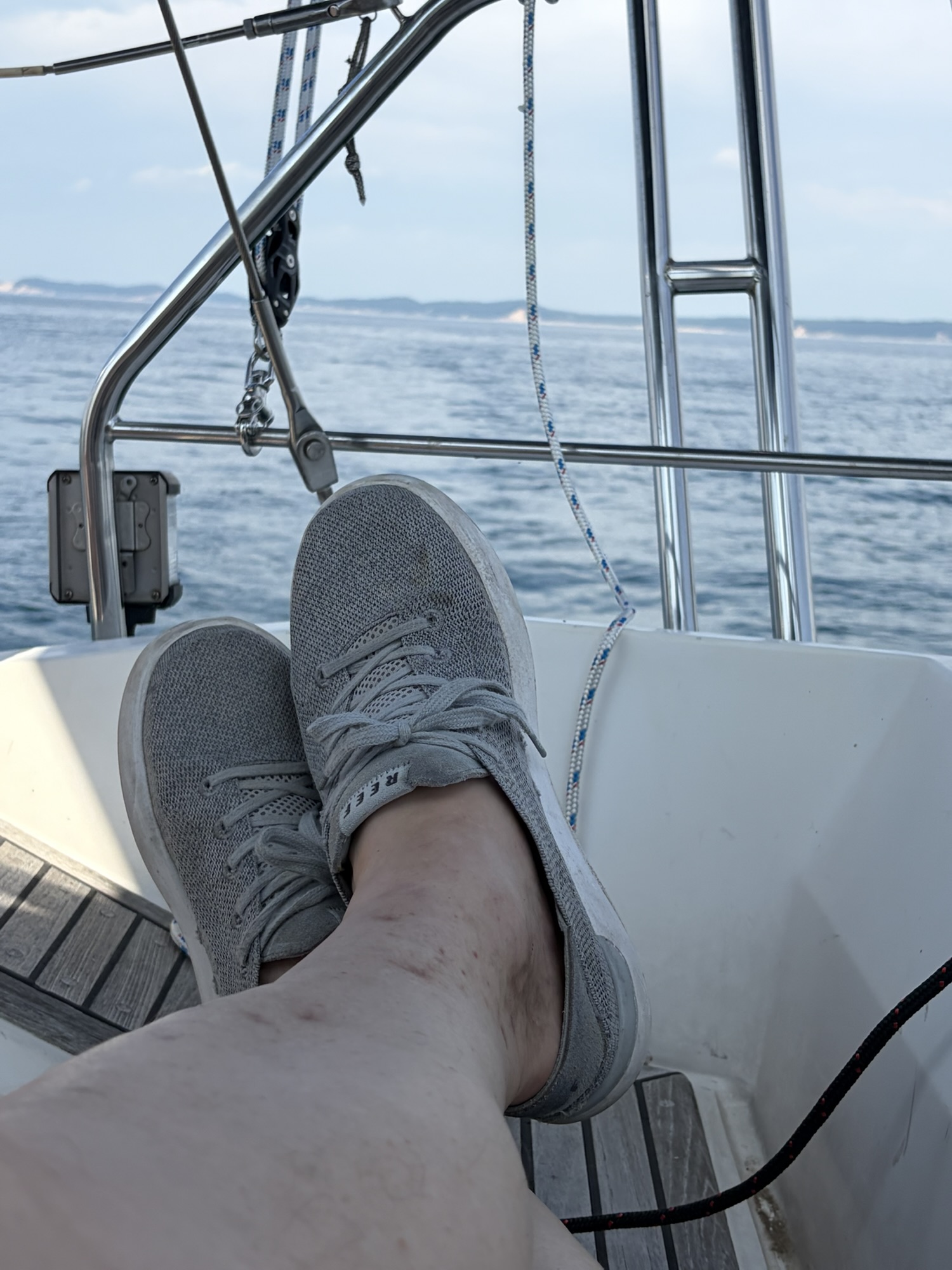
Back when I was living aboard my Nauticat 43 in Ventura, I discovered something about boats. The first time a problem happens, it’s a story. The second time, it’s a design flaw.
Recurring problems never go away. They have to be dealt with.
For example, you could never tell when the holding tank was filling up until the sensor was exceeded and the toilet simply stopped working. That could happen at a very inconvenient time. Once is a major inconvenience… maybe even a funny story. When it happens a second time, it’s time to find a solution.
On that boat, the blackwater holding tank was plastic, so I developed a capacitive sensor that mounted on the outside of the tank and could roughly estimate how much waste was inside. The sensor reported through WiFi to a little Raspberry Pi computer I had onboard that cared about things like that. The Pi then broadcast the information to gauges on my phone, iPad, and navigation displays so I always knew how full the tank was.
Problem solved.
I still had to pump the tank out, but at least I knew when it needed to be done and could plan for it.
While living aboard that boat, I became a Certified NMEA Marine Electronics Installer. I essentially got paid to install electronic navigation systems on other people’s boats using equipment from companies like Raymarine, Navico, and Garmin.
Those systems exchange an incredible amount of information. Some of it is important. Most of it just exists because every manufacturer wants to sell another sensor, another display, or another black box. If you have a problem, the solution always seems to be, “Install another widget.”
That bothered me.
I already had all this information floating around the boat. Surely the boat could become smart enough to solve some of these problems without adding another expensive piece of hardware.
So I installed a Raspberry Pi to act as the central nervous system and began writing my own software, like the holding tank sensor.
When I eventually sold that boat, I don’t think the new owner ever really understood how smart it had become. None of those systems were obvious. They just quietly lived beneath the digital hood, making life onboard easier every single day.
Jump ahead a few years.
My new Nauticat, TBD, is really just a smaller version of that boat. Before I even bought her, I already knew I wanted to build on everything I had learned aboard the 43.
The first project was lighting automation.
The boat already knows what time it is. It knows sunrise and sunset. It knows whether I’m motoring, sailing, anchored, or tied to a dock.
Put all of that information together and the correct navigation lights become obvious.
You can never underestimate the human factor.
There are so many times I’ve gone ashore only to realize it’s getting dark and think, “Oh crap… did I turn on the anchor light?” Or I start the engine and realize there’s another switch somewhere that I was supposed to remember to flip.
It’s the remembering that’s the problem.
Technology to the rescue.
I installed a few inexpensive digital relays that simply watched what the boat was doing and automatically turned on the correct lights when needed.
The unexpected benefit?
When I’m returning to the boat late at night with both arms full of groceries or gear, I can pull out my phone while I’m still in the parking lot and turn on the deck lights before I even get there.
It’s a little thing.
Until you do it once.
Then I discovered the refrigerator wouldn’t turn on.
After some troubleshooting, I became convinced the thermostat had failed.
Wonderful.
It’s a European boat, so that thermostat was probably going to have to come from somewhere in Denmark.
Then I stopped.
“Wait a minute…”
“A thermostat is just a switch.”
I bypassed it temporarily and, sure enough, the compressor fired right up and started cooling the box.
The thermostat really was bad.
Rather than calling Denmark, I happened to have another one of those little digital relays sitting in my toolbox. I wired it into the system in place of the thermostat and had the Raspberry Pi monitor the wireless temperature sensor that was already inside the refrigerator.
Just like that…
Working refrigerator.
No expensive thermostat.
No waiting for overseas shipping.
The little Raspberry Pi that was already running the boat simply took over another job.
It worked surprisingly well.
It got me all the way from Baltimore to Lake Michigan without any real issues.
The beer stayed cold – at the time, that seemed like a perfectly reasonable engineering metric.
Eventually, though, I noticed something.
Food on the bottom would freeze while food near the top wasn’t quite cold enough.
So I added a circulation fan.
That helped.
But it was still mostly guesswork.
Then entered my new best friend…
ChatGPT.
The refrigerator was already working, but software is never really finished.
I had Chat review the control logic, and instead of replacing what I had built, it started suggesting dozens of little improvements. Some ideas we adopted immediately. Others we debated. A few we rejected. Everything got tested on the boat.
Together we rewrote the controller.
Today we’re running Version 2.8.
According to Chat, it’s become a “commercial-grade refrigeration state machine.”
I’m okay with that description.
What’s fascinating is that we accomplished all of this without adding a single piece of refrigeration hardware.
The system now understands when I’ve loaded the refrigerator with warm groceries.
It knows how to recover from that.
It manages circulation fans to extend compressor off-time.
It prevents unnecessary short cycling.
It supports pre-cooling before provisioning.
It’s fully adjustable.
Future versions will include lid-open detection, smarter power management, and the ability to automatically adjust how aggressively it cools based on ambient temperature, battery state, and available solar power.
All of that…
…running on the original 25-year-old compressor and evaporator that came with the boat.
I didn’t replace the refrigerator.
I replaced the thermostat with software.
That’s become the theme of this little boat.
I’m not trying to fill her with more gadgets.
I’m trying to teach the gadgets she already has to work together.
Sometimes the answer isn’t another sensor.
Sometimes it isn’t another display.
Sometimes the answer is simply teaching the boat to think a little harder.
And every now and then…
…it starts teaching me something too.
Leave a Reply